How a Retired Midwife from Anambra Helped Me Conceive in 31 Days — After 3 Years of Being Told Everything Was "Normal"
If you have been trying to conceive for more than a year — tracking your ovulation, taking your folic acid every morning, going for tests that all come back "normal" — and you still have nothing to show for it, I need you to read every word on this page.
If you have sat in a fertility clinic in Lagos, held a set of results that said everything was fine, and driven home in complete silence because you had just been told the most likely explanation for why you were not pregnant was that there wasn't one — stay with me.
If you have typed something like "why am I not getting pregnant if everything is normal" into Google at 2am, clicked through fifteen tabs, and closed your phone more confused and more frightened than when you started — this is for you.
You have tried the folic acid. You tried it faithfully for two years. You switched to a more expensive brand. You added a prenatal vitamin. You downloaded three different ovulation tracking apps and cross-referenced them against your basal body temperature chart.
You tried the strict diet. The pineapple. The seed cycling. The fertility teas from that Instagram shop that smelled like dried grass and cost you ₦8,000 a packet.
You went to the clinic. You did the scans. Your husband did his test. Everything came back normal. Or close enough to normal that they said it was fine. That you should just keep trying. Maybe consider IVF.
And every month — every single month — your period came anyway.
I know what that does to a woman. I know how the hope changes shape after the first year. How it gets quieter. More cautious. How you stop telling yourself "this could be the month" because the fall is too hard when it isn't.
I know what it does to a marriage. The way it turns intimacy into an assignment. The way you start to feel like your body is betraying not just you, but both of you. The way you watch your husband try not to look relieved when you say "it didn't work this time" because at least the pressure is off for another few weeks.
I know what it does at baby showers and naming ceremonies and on the family WhatsApp group when somebody announces their pregnancy and the congratulations emojis start flying and you type yours too because what else do you do.
The condition itself is not the worst part. The worst part is what it is slowly, quietly doing to your marriage. To the way you see yourself. To the woman you used to be before this swallowed everything.
You are not broken. Something is blocked. And blocked things — unlike broken things — can be fixed.
"I know. Because I carried it too."

My name is Chidi Okafor.
I am not a doctor. Not a nurse. Not a fertility specialist with a degree on the wall and a waiting list three months long.
I am just a woman who spent three years inside this problem. Three years of tracking, hoping, praying, consulting, testing — and being told, again and again, that everything was normal.
I have a degree in biochemistry from UNN. I understood the biology. I understood what my cycle was supposed to do. I tracked it with the kind of precision most women reserve for their bank accounts. I took my folic acid every single morning. I ate well. I prayed consistently. I did everything I was supposed to do.
And the best answer the fertility system in this country could give me was: we don't know why. Here is a quote for IVF.
I drove home. I walked into my flat in Surulere. And I did not cry.
I sat on the floor of my bedroom with every fertility-related text I owned and I started reading differently. Not looking for hope. Looking for the gap. The specific question nobody had thought to ask.
I found it at 1am.
My luteal phase was nine days long.
Nine days — sitting there in twenty-four months of cycle data I had been recording myself, completely visible to anyone who knew to look for it. Not one consultation. Not one investigation. Not one doctor in this entire city had ever asked me about it, measured it, or mentioned it as something worth checking.
I had been spending money on tests that were never designed to find what was wrong with me. The problem was not that my body was broken. The problem was that nobody had asked the right question.
But I'm getting ahead of myself.
Before I found the gap in the data — before I understood what was actually happening in my body — I was at a naming ceremony in my husband's family. And something happened there that changed everything.
It was November. My husband's younger cousin had just had her second child — a boy, born fat and healthy, the naming ceremony held in the family compound in Nnewi. The kind of gathering you cannot skip without causing an incident.
We drove six hours for it. Over a hundred people packed into the compound. The new mother receiving guests like a queen, her baby passed from arm to arm. Every woman over forty asking me and my husband when our own news was coming. The smiles we had both learned to wear.
I had been there for two hours when I noticed an old woman watching me from across the compound. She was not the kind of woman you miss. Tiny. Maybe seventy years old. White hair wrapped in a pale green headtie. Eyes that had seen forty years of births and knew something about bodies that no clinic had ever catalogued.
Her name, I learned later, was Mama Ngozi — a retired traditional midwife who had attended more births in that community than the nearest hospital had in thirty years. Women drove from three states to see her. She had delivered my husband's mother. She had delivered my husband.
She kept watching me. Not unkindly. Carefully.
Then she looked away. Said something to the woman beside her. And that woman glanced at me too.
I knew what they were discussing. I could feel it in the way only a woman who has been the object of that particular kind of pity knows how to feel it. My face went warm. I found something interesting to study in my cup.
I have never been more ashamed in my life.
The Discovery That Changed Everything
She found me an hour later. Near the kitchen, where I had gone to be useful and away from the crowd. She touched my arm the way older Igbo women do when they mean business — not gentle, precise.
"Come. I want to talk with you."
We sat together on a low bench behind the main building, away from the noise. She looked at me for a long moment. And then she said the five words I had needed someone to say for three years.
"The problem is not you."
I cried. Not the polite kind. Not the kind you do in a clinic hallway so the doctor doesn't see. The real kind. The kind that comes up from somewhere below your ribs and surprises you with how much it has been waiting there.
She let me cry. She didn't say anything. She just sat there on that bench with her small hands in her lap and waited until I was finished.
Then she spoke.
Mama Ngozi: "You people in Lagos. You spend ten thousand, twenty thousand, fifty thousand naira going to these fine clinics where they give you a paper that says 'normal' and send you home. Normal. What does that mean, normal? Normal means the machine they used did not break. It means your body passed the test they gave. But the test they gave — did they test the right thing? Did any of them sit with you and ask how many days after your ovulation your period comes? Did any of them ask about your blood — not the volume, the colour? Did any of them ask what your grandmother cooked when a woman in your family was preparing to carry? No. They did not ask because they do not know what to ask. The machine cannot ask. So they call it unexplained and send you to a more expensive machine. And still your body keeps doing what it has been trying to tell you for two years."
She shook her head. Not angry. Sad. The way you are sad when you watch someone struggle to open a door by pulling when all they need to do is push.
Mama Ngozi: "Your womb is not broken, my daughter. It is like a compound with a bad fence. Every planting season the seed goes in, the rain falls, everything is right — but the fence has a gap. Before the seed can take root, something comes in and disturbs the ground. The seed is good. The rain is good. The soil is good. But the environment — the ground the seed needs to hold — that environment keeps being disrupted before it has time to set. And nobody has fixed the fence."
Your body has a natural hormonal window. Every month, after ovulation, your body is supposed to produce enough progesterone to hold the uterine lining stable for long enough that a fertilised egg can travel down, implant, and send the signal that tells your body: a pregnancy has begun. Do not shed the lining.
This window takes at least ten to twelve days to complete. When that window is too short — when it closes at nine days, or eight days, or seven — the signal never arrives in time. Your period comes. The cycle ends. And you never knew that fertilisation may have happened at all.
But here is what nobody tells you: this window can be disrupted by five specific physiological patterns that standard fertility tests are simply not designed to detect. Patterns sitting in your body right now. Correctable. Overlooked. Invisible on the panels they ran — but completely real.
This is not unexplained infertility. This is unfound infertility. And unfound things, unlike unexplained things, can be found. And fixed.
Mama Ngozi: "It is not recurring. It is being recreated."
I sat with that for a long time.
Three years. How much money. How many tests. How many mornings with the little smiley face on the ovulation stick. How many nights trying to believe that this month was different.
And in all of that time — not one person had asked me the question that mattered. Not one consultation had looked at my cycle data the way I was now looking at it. It took one woman, sitting on a bench in a compound in Nnewi, to tell me what was actually happening.
"I can show you what to do," Mama Ngozi said. "It is not complicated. It is not painful. It does not require a clinic or a machine or a prescription. It requires patience, the right things taken in the right order, and five minutes every morning before the rest of your day begins. That is all."
She looked at me steadily.
Mama Ngozi: "Follow it exactly. No shortcuts. No skipping the parts that seem boring. And when the thirty-second cycle comes — just smile."
The First Few Days: Nothing
Day 1. I started the morning ritual she described. Warm water. Lemon. Ginger. The breathing sequence. The small, precise changes to what I was eating and when.
Nothing.
Day 2. Nothing. I felt the familiar pull of doubt. This is just food. This is just breathing. This cannot possibly be enough.
Day 3. Nothing. I went back through my notes. Re-read what Mama Ngozi had told me. Reminded myself that she had been doing this for forty years and I had been doing it for three days.
Day 4. I almost stopped. Not because nothing was happening — nothing had happened on all the other things I'd tried either. I almost stopped because the hope felt dangerous. Because hoping and being disappointed was starting to cost more than not hoping at all.
But I remembered what she said about the fence. About fixing the environment before expecting the seed to hold.
I kept going.
Day 5: The First Sign
Something shifted.
It was small. I might have missed it in another season. But I had been paying attention to my body for three years in the specific, exhausted way that only women on this journey know — and I noticed.
My energy was different. Not dramatically. Just cleaner. Less of the mid-afternoon flatness that had become so normal I'd forgotten it wasn't supposed to be there.
And something else. Something I noticed when I went to the bathroom that morning. Not gone. But different. Lighter. The kind of different that makes you stand very still and pay attention.
Day 6. Day 7. Then Something Broke Open.
By Day 7, the difference was undeniable. My body felt like it was doing something it hadn't done in a long time — or maybe had never fully done. Something was settling. Stabilising. The way a room feels after you've opened a window that's been stuck for months.
Day 8, I did the breathing sequence as usual. Then I went to make breakfast. Then I ate. Then I went about my morning.
It was only at noon that I realised I hadn't checked.
For three years, checking had been the first thing I did every morning. The first thing my body thought about when I woke up. Every morning, before prayer, before the bathroom, before anything — am I okay today? It was automatic. It was constant. It was exhausting in a way I didn't even have language for anymore because it had become so much a part of me.
And on Day 8, I forgot.
"I forgot to check. For the first time in three years, I forgot to check. That detail still gets me."
A woman who checks every morning for three years doesn't forget unless something has changed. Not because the checking stops being necessary — but because the body that was making her check has started doing something different.
But the real test was yet to come.
Friday Night
It was the second Friday after I started the protocol.
My husband reached for me in the dark. The way he used to before all of this — before intimacy became a timetable, before touch became a task with a purpose and a window and a consequence if the timing was wrong.
I didn't move away.
I want to say that carefully because if you are on this journey, you know what I mean. You know the way the body tenses before it can stop itself. The way something inside you braces. Not because you don't want him. Because wanting him has become so tangled up with the weight of what you are both carrying that the wanting and the weight have become almost impossible to separate.
That night, for the first time in I don't know how long, I didn't feel the weight.
I just felt him.
I cried afterward. He held me and he didn't ask why. He just held me. The way you hold someone who has finally come back from somewhere very far away.
"He held me like I had come back. Like he had been waiting at a door that had been closed for a long time and it had finally opened."
I Didn't Plan to Tell Anyone
I told one friend. Adaora — we had been friends since secondary school. She had been on the same journey, quietly, for even longer than me. She hadn't told me. I hadn't told her. That's how this thing works. You carry it in separate rooms and smile at each other's baby showers and pretend everything is fine.
When I told her, she cried on the phone.
She started the protocol the same week.
Then she told her cousin in Enugu. Who told her friend in Port Harcourt. A voice note. Then another voice note. Woman to woman, the way important things always travel in this country — not through announcements or advertisements but through one trusted voice saying to another: I found something. It worked. Listen.
I started receiving messages from women I had never met.
"I had been on folic acid for twenty-two months. My doctor kept saying everything was fine. I followed what Chidi described exactly. On my second cycle using the protocol, my luteal phase went from eight days to eleven days. I got a positive test on the third cycle. I am currently seventeen weeks pregnant. I cannot explain what it means to type those words."
"I did every test they gave me. Everything was normal. My husband's was normal too. They were preparing us for IVF and I could not afford IVF — not the real kind, not the kind that actually works. A friend sent me this. Within six weeks my cycle changed. The spotting I used to get before my period every single month — gone. I didn't understand what that meant until I read the guide and realised it had been a sign the whole time. My son is four months old now."
"They said because of my age, IVF was the better option. That natural conception after thirty-five with my results was unlikely. I was not ready to accept that. I was not ready to spend one million naira on something with a forty percent success rate when I did not even fully understand what was wrong with me. The Five Hidden Blocker framework — that is what changed everything for me. I had three of them. Three things sitting in my body that nobody had ever named. Once I knew what they were, I knew how to address them. I conceived naturally four months later. I am thirty-seven. They said it was unlikely."
"I was not even sure something was wrong. Fourteen months feels short compared to some women. But I had started to feel it — the anxiety, the monthly hope and disappointment, the way it was changing things between me and my husband. I did not want to get to three years. A colleague showed me this guide. The self-assessment in Chapter 2 — I scored high on inflammation and uterine lining. Both of them. The Foundation Reset in the first week changed my period within one cycle. The cramping I had lived with since my teens was almost gone. I conceived in the second cycle of the full protocol. I am due in August."
"What I will say is this. The Big Idea — the part about the environment, the fence, the seed — that is the thing that made everything make sense. Not just medically. Emotionally. I stopped feeling like my body had betrayed me. I started understanding it. And understanding it made me trust it again for the first time in years. Same ritual. Same ingredients. Same method. And my body finally did what it has always known how to do."
"I am not someone who believes in things easily. I am a civil engineer. I believe in things I can measure. What made me trust this was the self-assessment. It was specific. It was scientific. It gave me a framework that made biological sense. I identified my blockers. I followed the protocol for the blockers I had. My Day 21 progesterone went from 14 to 28 in one cycle. That is not a placebo. That is a measurable change in my hormonal environment. I was pregnant by month three."
Same ritual. Same ingredients. Same method. Same results.
Why I Am Sharing This
I went back to Nnewi four months after the naming ceremony. I went to find Mama Ngozi.
I sat with her in the same compound, on the same bench. I told her what had happened. Not just for me — for Adaora, for the women Adaora told, for the messages I was receiving from people I had never met.
She laughed. Not unkindly. The kind of laugh that says: of course. This is what has always happened when women share knowledge with other women.
I asked her if I could write it down. Document everything she had shared with me — the protocol, the framework, the specific steps — so that women who would never make it to a bench in Nnewi could still receive it.
She was quiet for a moment.
Then she said yes.
Mama Ngozi: "Do it. But make sure they follow exactly. No cutting corners. No taking the parts they like and leaving the parts that seem inconvenient. The protocol is a sequence. The sequence matters. And make sure they know — they were never broken. They were never cursed. They were never forgotten. They were just never given the right question."

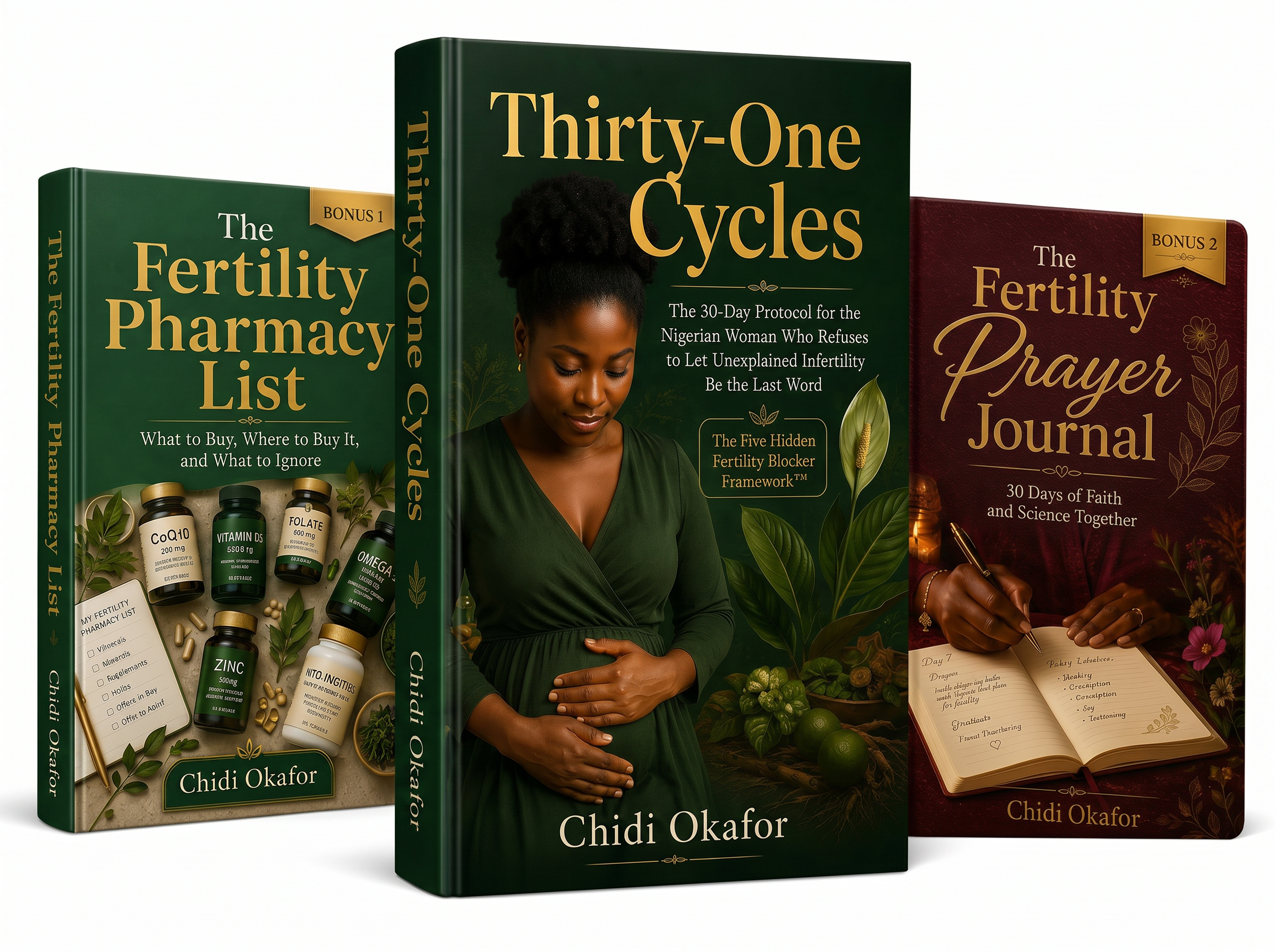
Everything Mama Ngozi taught me — and everything I found at 1am on the floor of my bedroom in Surulere — is now documented in these 38 pages. Organised. Structured. Written in plain language so you can understand exactly what has been happening in your body, identify which of the Five Hidden Blockers are operating in yours specifically, and begin the protocol tonight.
No clinic required. No prescriptions. No grinding, no steaming, no inserting anything. Everything in this guide uses foods and supplements available in any Lagos market or major Nigerian pharmacy. Total cost of materials? Less than ₦20,000. And it starts working on your hormonal environment from the very first day.
- The Five Hidden Fertility Blocker Framework™ — The complete self-assessment that identifies which of the five correctable physiological patterns are operating in your body specifically. Most women identify two or three. This is the diagnosis standard testing never gave you. (Chapter 2, Page 10)
- The Foundation Reset — Week One Protocol — The exact food changes, morning ritual, and gut-inflammation reset that prepares your body to respond to everything that follows. Without this foundation, the other interventions underperform. (Chapter 3, Page 17)
- The 90-Day Egg Quality Push — The complete supplement stack — including the specific forms most Nigerian women are getting wrong — with exact doses, timing, and where to find each item in Lagos. CoQ10. Methylfolate. Vitamin D3 with K2. NAC. Explained in plain language. (Chapter 4, Page 23)
- The Cycle Sync Protocol — What to eat and supplement in every phase of your cycle — menstruation, follicular, ovulation, and luteal — so that every intervention lands at the exact moment your body is most prepared to receive it. This is the difference between results and guesswork. (Chapter 5, Page 29)
- The #1 Mistake Women Make in Their Luteal Phase — The early testing habit that is actively disrupting your implantation window every single month. The chapter that changes this one pattern alone has produced measurable results. (Chapter 5, Page 34)
- The 8-Minute Pelvic Circulation Sequence — A daily movement sequence specifically designed to increase blood flow to the uterus, reduce pelvic tension, and lower the cortisol that is suppressing your LH surge. Takes eight minutes. Done at home on a mat. No equipment. (Chapter 6, Page 37)
- The Hidden Habits That Recreate the Problem Monthly — The processed vegetable oils, the white bread, the specific supplement forms your body cannot absorb — and exactly how to replace them with locally available alternatives your body can actually use. (Chapter 3, Page 19)
- The Doctor's Appointment Toolkit — The exact tests to request, the specific numbers to ask about, and the words to use so you leave every consultation with real information — not a "normal" result that means nothing. (Chapter 7, Page 46)
You do not need to travel anywhere to use this protocol. Everything you need is available in your local market or a major pharmacy near you. Total cost of materials? Less than ₦20,000.
Compare That to What You Have Already Been Spending
How Much Does This Guide Cost?
Let me show you what it cost me to build it.
Three years of personal cycle data, documentation, and research — ₦0 in money, immeasurable in time and pain. But I am not charging for my suffering. I am charging for what it produced.
Professional medical research review and verification — ₦85,000. I had every claim in this guide cross-referenced against published fertility research by someone who knew how to read a clinical trial. This is not a wellness blog post. It is an evidence-informed protocol.
Guide writing, editing, and structuring — ₦40,000. So that what took me three years to piece together takes you thirty minutes to understand.
Design and layout (38 pages, formatted for readability) — ₦25,000.
Delivery technology (the system that sends your guide to WhatsApp and email within sixty seconds of purchase) — ₦18,000.
Total investment to build this: ₦168,000+.
A fair price for what this guide contains — the exact information that three years of consulting, testing, and ₦300,000+ in fertility spending never gave me — would be ₦75,000. And it would still be the best ₦75,000 a woman on this journey ever spent.
But I know what times are like. I know that the women who need this most are also the women who have already spent the most on things that didn't work. So if you act today —
Once You Click That Button, Here Is What Happens
- You are taken to a secure payment page. Enter your details and complete payment safely. The process takes less than two minutes.
- Your payment is confirmed automatically. The system processes it immediately — no waiting, no manual checking, no business hours required.
- Your guide — plus all bonuses — is delivered directly to your WhatsApp number and email address within 60 to 90 seconds of payment confirmation. Not tomorrow. Not in 24 hours. Within 90 seconds.
It is me, Chidi. As long as your payment is confirmed, your access is 100% guaranteed. Every time, within seconds.
What Happens In The First 7–14 Days
Real conversations. Real women. Real results.
WAIT — I Have Something Special For You…
If you are one of the first 100 women to purchase today, you also receive these two bonuses — completely free.

There is a specific frustration that nobody warns you about when you start buying fertility supplements in Lagos. You walk into a pharmacy with your list. You know what you need. And they hand you something that is almost what you asked for — but not quite. Ubiquinone instead of ubiquinol. Standard folic acid instead of methylfolate. You stand in the car park for forty-five minutes trying to work out if they are the same thing.
They are not. And the wrong form can mean six months of taking something faithfully that your body cannot absorb.
This bonus is a complete, Lagos-verified supplement sourcing guide for every item in the Thirty-One Cycles protocol. The exact forms. The exact brands. Where to find them in Lagos by name. What to say at the counter. What to refuse when they try to substitute. Three budget levels — economy, standard, and optimal — with prices that reflect what you will actually find on the shelf. And a WhatsApp ordering script for purchasing online that protects you from the most common sourcing mistakes women make.
You will never stand confused in a pharmacy car park again.
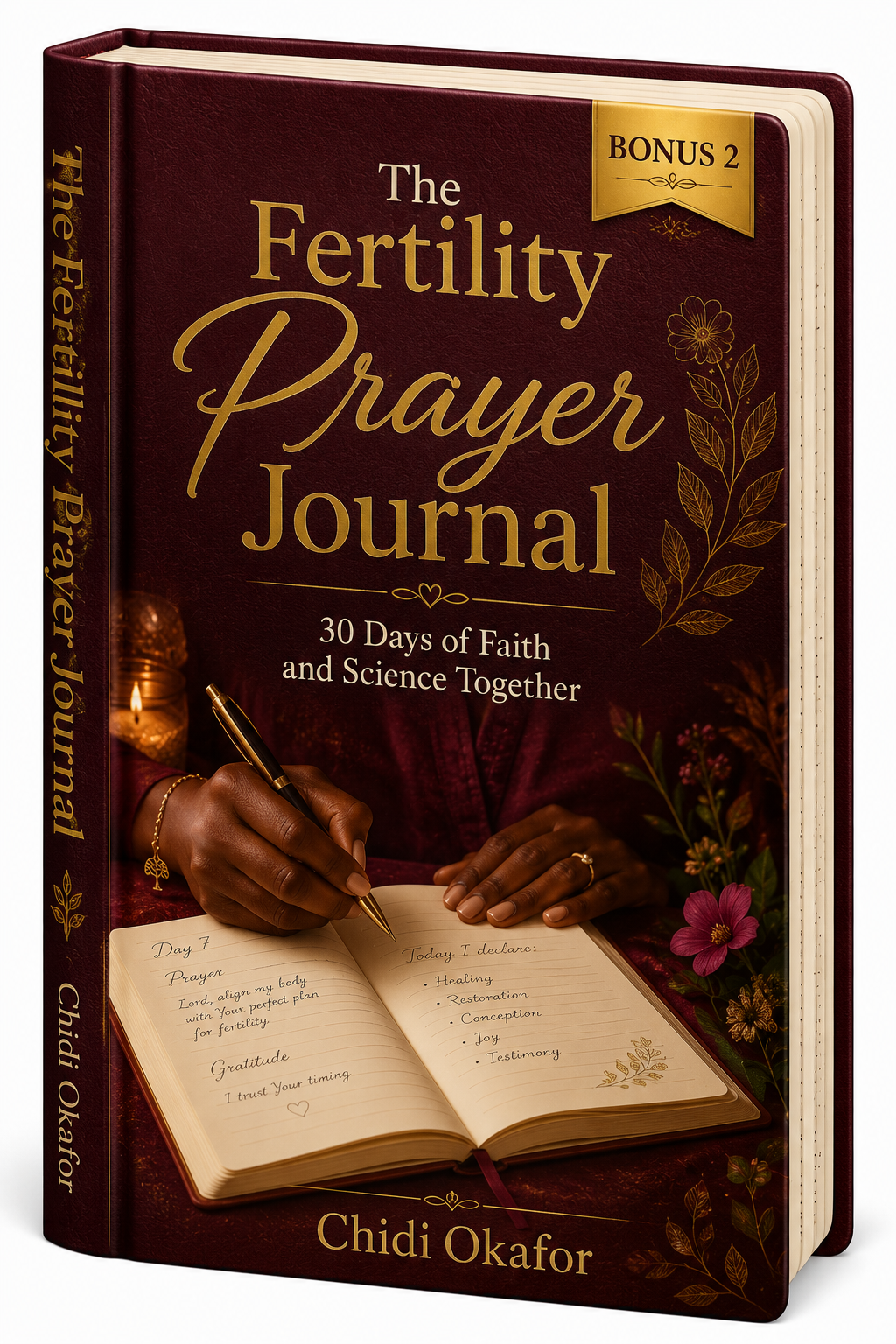
Nobody tells you about the tension between faith and this journey. People at church tell you to surrender. To trust God. To stop striving. And meanwhile you are tracking your cycle and taking your supplements and lying awake calculating days and wondering quietly if the supplements on your bedside table are a form of unbelief.
They are not. Your body is not separate from your faith. Your biology is not in competition with your God.
This journal holds both. Thirty days of daily protocol tracking pages and guided reflection prompts — one for each day of the Thirty-One Cycles protocol. Each day, you check your supplements, record your cycle observations, and sit with a single reflection prompt that goes somewhere real. Not devotionals written for a general audience. Prompts written specifically for a woman who is doing everything right and has not received an answer yet, and who needs a place to put all of it — the hope, the science, and the God who holds both.
Use a pen. Not your phone. You deserve 30 days of honest conversation with yourself.
Everything You Are Getting Today
- Thirty-One Cycles™ — The Main 38-Page Protocol Guide
₦75,000 - BONUS 1: The Fertility Pharmacy List — What to Buy, Where to Buy It, What to Ignore
₦12,000 - BONUS 2: The Fertility Prayer Journal — 30 Days of Faith and Science Together
₦8,500
Right Now, You Have Two Choices
If You Do Nothing
- Next month's cycle arrives exactly as the last thirty-one did.
- The environment that has been disrupting implantation every month continues undisturbed — because nobody fixed the fence.
- The tests will still say "normal." The consultations will still end with "keep trying."
- Another baby shower. Another naming ceremony. Another year of wearing the smile you have spent two years perfecting.
- The woman you used to be — before this swallowed everything — gets a little further away.
If You Get the Guide Today
- By tonight, you have the self-assessment. By tomorrow morning, you know which of the Five Hidden Blockers are yours. For the first time, you have a name for what has been happening.
- By Day 7, your body is in a different hormonal environment than it has been in months. The foundation is changing.
- By the end of Month 1, your luteal phase is lengthening. The window your body needs to hold implantation is getting longer.
- By Month 3, the eggs developing now are developing in the environment this protocol is building — an environment that was never available to them before.
- The thirty-second cycle becomes possible. Maybe the thirty-third. But possible in a way it has never been before, because the environment has finally changed.
Main Guide + Bonus 1: Fertility Pharmacy List + Bonus 2: Fertility Prayer Journal
₦75,000 ₦9,500One-time payment. Instant delivery to your WhatsApp and email.
🛡 30-Day Money-Back Guarantee
Follow the Thirty-One Cycles protocol for thirty days — exactly as described, without shortcuts. Complete the morning ritual daily. Take the supplements consistently. Follow the food protocol. Do the pelvic sequence. If at the end of thirty days of full, consistent effort you have seen no measurable change in your luteal phase length, your period quality, or your cycle — send me a message and I will refund every naira. No lengthy questionnaire. No argument. Full refund. Because I am confident enough in this protocol to stand behind it completely.
One Last Thing…
Picture yourself one month from today.
Will you know — finally, specifically — which physiological patterns have been blocking your conception? Will you have a name for what has been happening, instead of "unexplained"?
Will your body be in a different hormonal environment than it has been in for months? Will the fence be fixed?
Will you be sleeping better, moving better, feeling lighter in a way your husband notices before you say anything?
Will you be walking into your next cycle with a real plan — not hope, not guesswork, but a targeted protocol that addresses the specific patterns in your specific body?
Will you be one month closer to the thirty-second cycle?
Now picture yourself one month from today if you close this page.
Everything stays the same. The tests still say "normal." The cycles still count. The environment that has been recreating the problem every month — untouched.
The difference between those two versions of you is a decision you make in the next sixty seconds.
If you have read this far and you are still hesitating —
I want to say something direct.
The hesitation is not about ₦9,500. You have spent far more than ₦9,500 on things that left you with a "normal" result and no answers. The hesitation is something else. It is the part of you that has been disappointed so many times that hoping feels dangerous. It is the part that would rather not try than try and fail one more time.
I understand that. I carried it for three years. The hope-armour. The careful not-believing-too-much.
But here is what that armour costs you: the very protection that keeps you from being hurt is the same protection that keeps you from beginning. And beginning is the only way the thirty-second cycle becomes possible.
If you cannot invest ₦9,500 in fixing the environment that has been blocking your conception for two years — the same ₦9,500 that comes with a full 30-day money-back guarantee — ask yourself honestly: how do you expect your body to hold what you are hoping it will hold?
The guide is ready. The protocol is waiting. The fence can be fixed today.
Stop hesitating. Choose yourself.
P.S. — The 30-day money-back guarantee is real and unconditional. Follow the protocol for thirty days with full consistency, see no measurable change in your cycle, and I will refund every naira. No questions. You have nothing to lose and the answer you have been looking for to gain.
P.P.S. — This is the launch price: ₦9,500 for the guide plus both bonuses. This price will not last. Once the launch window closes, the price returns to ₦19,500. If you are reading this, the launch price is still available — but only if you act now.
P.P.P.S. — Every day you wait is another cycle in the same environment. Another morning of the same morning ritual that has not been working. Another month of the fence staying broken. The thirty-second cycle does not begin until something in the environment changes. That change begins the day you decide it does. Today can be that day.
Frequently Asked Questions
How is the guide delivered? I am not very technical.
The moment your payment is confirmed — usually within 30 seconds — the system sends your guide and all bonuses directly to both your WhatsApp number and your email address. You do not need a special app, an account, or any technical knowledge. The guide arrives as a PDF you can open, read, and save directly on your phone. Most women have it open and are reading within two minutes of paying.
Are the ingredients and supplements easy to find in Nigeria?
Yes. The protocol was specifically designed for Nigerian women using foods and supplements available locally. The food protocol in Chapter 3 uses ugu leaf, mackerel, garden eggs, ofada rice — all available at your nearest market. The supplement stack is detailed in the Bonus 1 Pharmacy List, which tells you the exact brands, which pharmacy chains in Lagos carry them (Health Plus, Medplus), and how to order online when local stock is unavailable. The guide also includes a three-tier budget breakdown so you can start at whatever level your current budget allows.
What if my situation is severe — I have been trying for more than 3 years?
The Five Hidden Blocker Framework was developed specifically from the experience of women who had been trying for two, three, four years and had been told their results were normal. Long duration does not necessarily mean the blockers are more severe — it often means the right questions were never asked sooner. Chapter 7 includes the Doctor's Appointment Toolkit with specific tests to request and specific numbers to discuss with your doctor, so you can pursue the protocol alongside any medical support you may already be receiving. The guide also includes a clear "when to escalate" framework that tells you specifically when medical support should be added to the protocol.
What if my husband is sceptical?
Chapter 7 includes a full Partner Conversation Guide — the specific words to use, when to have the conversation, and how to invite him into the journey without making him feel blamed or overwhelmed. Many husbands, once they understand the biological framework and see the measurable changes in their wife's cycle, become the most consistent supporters of the protocol. The guide also explains why the same dietary changes that support your fertility directly support male sperm quality — so he is not doing something separate for your benefit, he is doing something beneficial for both of you.
Is the money-back guarantee actually real?
It is fully real and unconditional with one condition: you follow the protocol as described for thirty days. Full morning ritual daily. Full supplement stack consistently. Full food protocol. Pelvic sequence daily. Cycle tracking. If after thirty days of genuine, consistent effort you see no measurable improvement — no change in luteal phase length, no change in period quality, no change in energy or cycle signs — send a message to the contact provided with your order and you receive a full refund. The guarantee exists because the protocol works when followed, and the only way to remove the risk from your decision is to remove it completely.
How is this different from everything else I have already tried?
Everything else you have tried — folic acid, ovulation tracking, fertility teas, standard prenatal vitamins — was designed for women without hidden physiological blockers. If you don't have any blockers, the standard approach works. If you have even one of the Five Hidden Blockers — and many women who struggle to conceive have two or three — the standard approach does almost nothing. Not because it is wrong. Because it is incomplete. Thirty-One Cycles does not replace good general fertility practice. It goes underneath it, to the level the standard approach was never designed to reach, and addresses the specific patterns that have been quietly preventing your conception. That is the difference. It is not a different kind of hope. It is a different level of investigation.
Leave a Comment