How a Quiet ADHD Researcher Helped Me Stop Losing My Days Before They Even Began — In Just 7 Days
If you wake up every morning intending to have a productive day — and still watch it disappear — read every word on this page.
If you have told yourself "today will be different," only to find yourself at 3pm wondering where the morning went — this is for you.
If you have downloaded every productivity app available on your phone. Bought planners. Watched YouTube videos about morning routines. Written goals in a journal. And still cannot seem to get your day off the ground — keep reading.
Because the problem is not what you think it is.
It is not laziness. It is not lack of discipline. It is not that you are simply not "a morning person."
The problem is that every system you have ever tried was designed for a different kind of brain.
Not yours.
You wake up with intention. Real intention. Your list is ready. Your goals are clear. You know exactly what you are supposed to do.
Then you check one notification.
And somehow — two hours later — you have done almost nothing on that list. You feel behind. You feel ashamed. And that familiar heaviness settles in. The one that whispers: "You will never change. This is just who you are."
That voice is lying to you.
But here is what makes this pain worse. It is not just about the lost time. It is about what the lost time costs you.
The project you keep pushing back. The business you told yourself you would start this year. The promotion you are watching colleagues get because they seem to have something you cannot figure out. The version of yourself you can see clearly but cannot seem to reach.
You are not broken. But you are running on the wrong system.
I know. Because I ran on it for years too.
"I know. Because I spent years inside this same chaos — and the answer was never more discipline. It was a better runway."

My name is Zuri Mensah.
I am not a doctor. Not a therapist. Not an academic with letters after my name.
I am a productivity researcher who spent years studying one very specific problem: why do intelligent, motivated people with ADHD keep losing their mornings — no matter how hard they try?
I grew up watching people around me struggle with this. Friends who were clearly brilliant. Colleagues who could articulate exactly what they wanted to achieve. Family members who cared deeply about their futures.
And yet — every Monday was a "fresh start." Every new planner lasted two weeks. Every productivity app became background clutter on a phone screen.
I became obsessed with understanding why.
I spent years reading research on attention, habit formation, dopamine, cognitive transitions, and behavioral psychology. Not the motivational stuff. The actual science of how ADHD brains process the shift from sleep to focused action.
What I found changed everything I thought I knew about productivity.
The conventional advice — wake up earlier, make a to-do list, find your "why," push harder — was not just ineffective for ADHD brains. In many cases, it was actively making things worse.
More pressure. More decisions. More chances to fail. More evidence that you were "not disciplined enough."
The real problem was never motivation. It was never character. It was never laziness.
It was the transition.
The gap between waking up and actually being in focused, productive motion. That gap — and nobody was talking about how to close it for ADHD brains specifically.
I spent years testing, refining, failing, adjusting. Hundreds of iterations. Real people. Real mornings. Real results.
And what emerged was something I never expected to be so simple.
The Morning Everything Shifted
There is a moment I still think about.
I was in Ibadan — visiting a colleague who ran a small ADHD support group there. Nothing formal. Just a room of adults, mostly in their late twenties and thirties, sharing what was and was not working for them.
The stories were painfully familiar. A man who had been fired twice — not for incompetence, but for consistently missing morning deadlines. A woman who ran a business she loved but could not get herself to open her laptop before noon. A university lecturer who prepared brilliant lectures the night before — then spent the morning so scattered he sometimes arrived late to his own class.
All of them had tried the standard advice. All of them had failed. All of them had concluded, privately, that the problem was them.
In the corner of the room sat an older man. Quiet. He had said almost nothing for the first hour. His name was Dr. Emeka Okonkwo — a retired cognitive behavioural researcher who had spent thirty years working with attention and learning differences across Nigeria and the UK. He had come, he said, simply to listen.
He listened for a long time.
Then he spoke.
The Discovery That Changed Everything
He did not stand up. He did not raise his voice. He just leaned forward slightly, looked around the room, and said five words that stopped everything.
"You are not broken. You are unsequenced."
Nobody moved.
He continued.
The room was so quiet I could hear traffic outside.
He was not finished.
Something cracked open in me as he spoke.
Not dramatically. It was quieter than that. The kind of shift that feels like finally understanding a word you have been mispronouncing your whole life.
The Core Insight
Your brain has a natural activation sequence. A specific order of mental states it needs to pass through before focused, sustained action is possible.
When that sequence is disrupted — when you jump from sleep straight into stimulation, notifications, decisions, other people's urgency — your attention scatters. And it stays scattered. Not because you lack willpower. Because the environment captured your attention before you had a chance to direct it yourself.
Everything you "try" after that is just mopping the floor with the tap still running. You are fighting consequences instead of fixing the cause.
The cause is simple: you never built a runway. You never designed a predictable, low-friction sequence that moves your brain from sleep to focused action without giving distraction a chance to hijack the process.
Once you have a runway, something remarkable happens. The morning stops being a battle. It becomes a path. One you follow the same way every day — until it is no longer something you do. It is simply who you are in the morning.
I went home that night and did not sleep much. I kept turning that idea over in my mind.
All those years. All those planners. All those mornings I had called myself lazy, undisciplined, broken. And the whole time, the issue was not character. It was structure. Or rather — the absence of it at the exact moment it was most needed.
It took one man, in a quiet room in Ibadan, to tell me what was actually happening.
Over the following months, I went back to my research with completely different eyes. I rebuilt everything I thought I knew about ADHD and morning productivity around one central question: how do you design a morning sequence that works with the ADHD brain instead of against it?
The system I developed is called The Morning Activation System™.
It is not a rigid routine. It is not a 5am wake-up challenge. It is not a list of habits to force on yourself.
It is a five-gate sequence — each gate handling one critical transition point between sleep and focused action. It takes less than thirty minutes. It requires no special equipment. You do not need to meditate, journal, or cold plunge. You do not need to be a morning person.
You just need to follow the sequence. In order. Without shortcuts.
The First Few Days: Nothing
Day 1. I followed the sequence. Gate 1 — no phone for the first fifteen minutes. Water. Light. Gentle movement. It felt strange. Almost too simple. I kept waiting for the dramatic shift that productivity content always promises. It did not come.
Day 2. Same thing. I followed the gates. Got to my desk. Started my anchor task. It felt slightly less effortful than usual, but I told myself I was imagining it.
Day 3. I nearly quit. Nothing felt different enough to justify changing habits I had carried for years. I remembered what Dr. Okonkwo had said: "Give it seven days." So I kept going.
Day 4. Still skeptical. But I noticed — I had not once, in four days, arrived at 11am wondering where the morning went. That was new. I did not know what to do with that yet.
Day 5: The First Sign
Something shifted on Day 5. I cannot explain it as a dramatic breakthrough. It was quieter than that.
I sat down at my desk and started working before I had consciously decided to. Not because I was forcing myself. Not because I felt particularly motivated. I just — moved into it. Like water finding a channel that had been cleared for it.
The resistance that usually lived between intention and action was smaller. Not gone. Smaller.
By mid-morning I had completed more focused work than I typically managed in a full day. I sat back and thought: what just happened?
Day 6. Day 7. Then Something Broke Open.
By Day 7, something happened that I still find difficult to describe without sounding like an exaggeration.
I forgot to check whether the sequence was working.
I had spent years monitoring my own productivity like a patient taking their own pulse. Every morning — am I focused? Is this going to be a good day or a bad day? Am I behind? Am I losing time?
On Day 7 I did not ask any of those questions. I followed the sequence, sat down, and worked. And hours later I realised I had not once stopped to evaluate whether I was "doing okay."
I was just doing.
"I forgot to check if it was working. For someone who had monitored his own focus every single morning for years — forgetting to check was the proof."
But the real test was yet to come.
The Conversation I Did Not Expect
Three weeks in, my partner — who had watched me struggle with this for years — sat across from me at dinner and said something I was not prepared for.
"You seem different lately."
Not dramatically different. She was not describing some transformed person. She was describing something subtler. Something in the way I was present at the dinner table. The way I was not mentally somewhere else, running through the list of things I had not done. The way I was not carrying the weight of another failed day.
"You seem like you are here," she said. "Like you are actually here."
I did not say much. I just nodded. Because I did not trust my voice in that moment.
Because she was right. For the first time in longer than I could remember — I was there. Not just physically. My mind was not haunted by the morning I had wasted. Because I had not wasted it.
"She said I seemed like I had come back. And in every way that mattered — I had."
I Did Not Plan to Tell Anyone
I kept the system to myself for a while. It felt too personal. Like something that had worked specifically for me and might not translate.
But I told one person. A colleague in Lagos — Adaeze. She had ADHD and had been through everything I had been through. I told her what I had built. She tried it.
Two weeks later, she called me. She was laughing. Not the polite laugh of someone being encouraging. The real kind — surprised, almost disbelieving.
"Zuri. What did you do to my mornings?"
She told a friend. That friend told another. Voice notes started moving between women and men across Lagos, Abuja, Port Harcourt — people who had struggled for years and suddenly had a framework that actually fit how their brains worked.
Here is what some of them said.
"I had tried everything. I had a drawer full of planners that lasted two weeks each. I had three different productivity apps on my phone that I had not opened in months. When Zuri sent me this, I nearly did not read it. I am so glad I did. By Day 6, I sat down and worked for four uninterrupted hours. I cried when I realised what had just happened. Not because it was dramatic. Because it was so quiet. So normal. Like this was just how mornings are supposed to feel."
"I am a freelance designer. Late mornings were killing my business. Clients thought I was unreliable. I thought I was unreliable. The five-gate sequence changed something fundamental in how I enter my workday. I now deliver before deadlines consistently. That has never been true of me before in my adult life."
"I am a mother of three and I run a business. I had completely given up on the idea of productive mornings. I assumed my season of life made it impossible. This system showed me that the season was never the problem. The sequence was. I now do more focused work before 10am than I used to do all day. My children have noticed. My husband has noticed. I have noticed myself."
"I was skeptical because I am an engineer and I like to understand the mechanism before I trust the result. So I read the explanation carefully first. It made sense. The dopamine piece, the transition piece — it all tracked with what I had been experiencing but never had language for. I tried it. The results were not gradual. Day 5 was a wall I walked through. I have not looked back."
"I am a final year student and I have struggled with ADHD my whole academic life. I thought it would always be this way — that I would always need three times the effort to produce half the results. This system does not make the work easier. It makes the starting easier. And for ADHD, starting is everything. Once I am moving, I can stay moving. The runway gives me that movement."
"My wife noticed before I did. She said I was not checking my phone at breakfast anymore. She said I seemed less stressed in the morning. I had not realised until she mentioned it. The system becomes automatic faster than you expect. I do not think about the gates anymore. I just move through them."
Same sequence. Same five gates. Same results.
Why I Am Sharing This
I went back to Dr. Okonkwo six months after that evening in Ibadan. I told him what had happened. The system I had built. The people it had helped. The feedback that kept coming in from across the country.
He listened the same way he always listened — quietly, completely. Then he laughed. Not a polite laugh. A deep, satisfied laugh, the kind that comes from a person who spent thirty years believing in something and finally seeing it proven right.
I asked him if I could document the system properly. Publish it. Make it accessible to everyone who needed it.
He agreed without hesitation. But he had one condition.
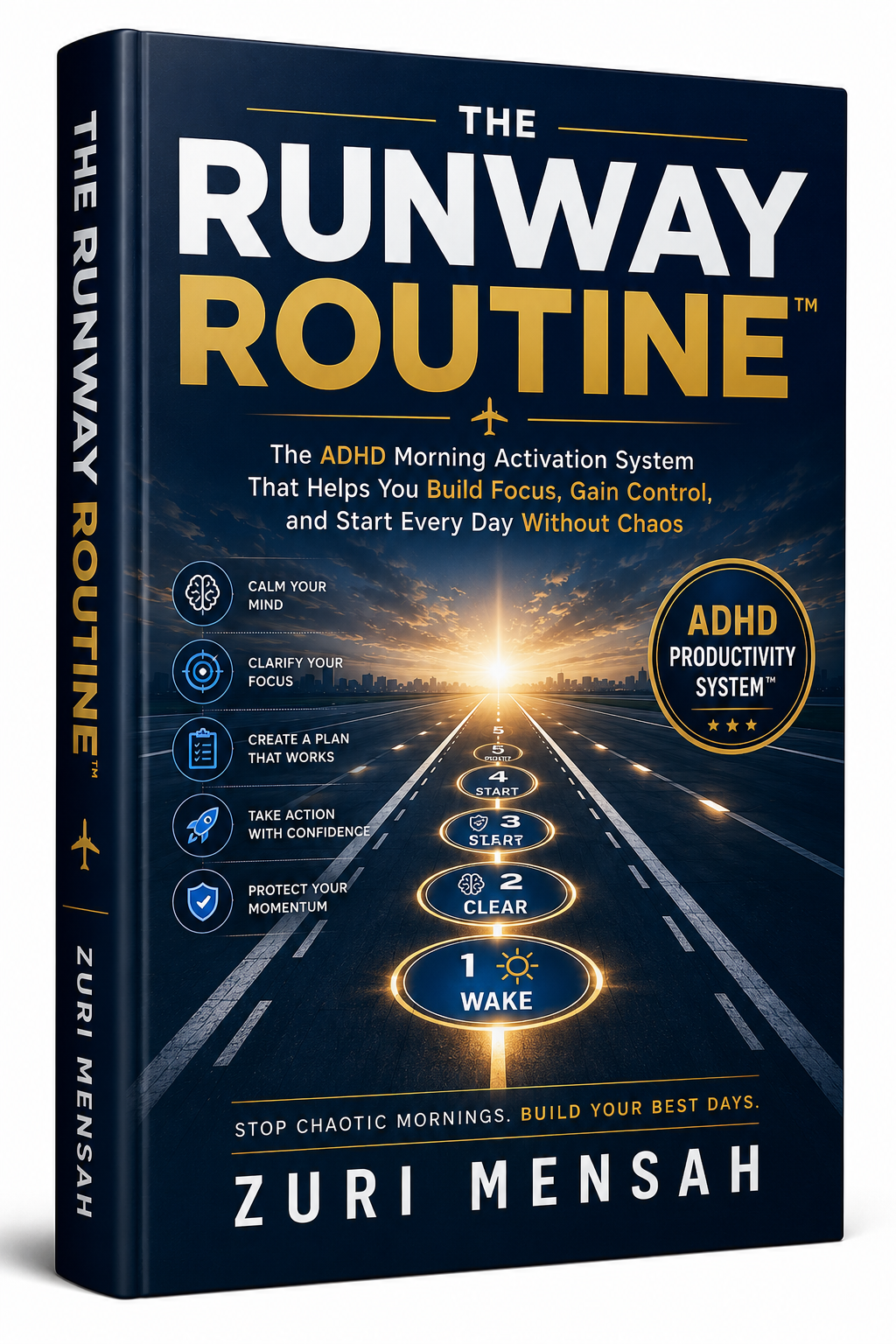
The Runway Routine™
The ADHD Morning Activation System That Helps You Build Focus, Gain Control, and Start Every Day Without Chaos
Everything Dr. Okonkwo explained in that room in Ibadan — and everything I spent years researching, testing, and refining — is now documented in plain language, structured step by step, so you can follow it starting tonight and feel the difference by Day 5.
No jargon. No impossible habits. No 5am alarm. Just a five-gate sequence that works with your ADHD brain instead of fighting it.
Here is exactly what is inside:
- The Morning Activation System™ — The Complete Five-Gate Sequence (Page 1) — The exact order of steps your brain needs to transition from sleep to focused action. Explained clearly, with the science behind each gate in plain language.
- Gate 1: Wake-Up Activation Protocol (Page 8) — The specific morning sequence that prevents your attention from being hijacked before you even sit down. What to do in the first 10 minutes and why the order matters.
- Gate 2: The Brain Clearance Method (Page 14) — How to empty mental clutter before it paralyses your morning. The three-step unload process that reduces decision fatigue before it begins.
- Gate 3: The Flight Plan Framework (Page 22) — How to choose your 3 priorities for the day in under 5 minutes — and identify the one anchor task that makes the day count regardless of what else happens.
- Gate 4: The Engine Ignition Technique (Page 31) — The #1 mistake ADHD adults make when trying to start tasks — and the micro-start method that removes resistance entirely. Includes the 5-Minute Entry Protocol.
- Gate 5: The Momentum Protection System (Page 40) — How to stay inside focused work long enough for real progress to happen. The Single Window Rule, the 10-Minute Lock, and the Return Line technique.
- The ADHD Emergency Restart Protocol™ (Bonus Section) — What to do when you miss a day, break the sequence, or fall back into old patterns. The three-step recovery that stops a bad morning becoming a bad week.
- The 30-Day Runway Routine™ Action Plan (Page 55) — A day-by-day implementation guide for the first month. Includes which gates to add when, what to expect at each stage, and how to troubleshoot the most common failure points.
You do not need to travel anywhere. You do not need to buy any equipment. Everything this system requires is already available to you wherever you are. The total cost of materials? Zero. Everything you need is already in your home.
Compare That to What You Have Already Been Spending
How Much Does This Guide Cost?
Let me be transparent about what went into building this. This is not a quickly assembled PDF.
- Years of ADHD productivity research and framework development — ₦0 (priceless in time)
- Professional content writing and structural editing — ₦45,000
- Research verification and accuracy review — ₦20,000
- PDF design and layout — ₦18,000
- Real-world testing with ADHD adults across Nigeria — ₦0 (but months of iteration)
- Platform setup, delivery infrastructure, tech — ₦12,000
A fair price for this, given the value it delivers, would be ₦25,000. That is what it is listed at.
But I know that times are tight. And I know that what matters most right now is getting this system into the hands of as many people as actually need it. So if you take action today —
Once You Click That Button, Here Is What Happens
- You are taken to the secure payment page. Simple, fast, private.
- You complete your payment. One-time. No subscription. No recurring charges.
- Your guide is delivered to your WhatsApp AND your email within 60–90 seconds. You can start reading tonight and begin the sequence tomorrow morning.
It is me, Zuri Mensah. As long as your payment is confirmed, your access is 100% guaranteed. No waiting. No manual processing. Straight to you.
What Happens In The First 7–14 Days
Real conversations. Real people. Real results.
WAIT — I Have Something Special For You…
If you are one of the first 100 people to order today, you will also receive these three additional guides — completely free:
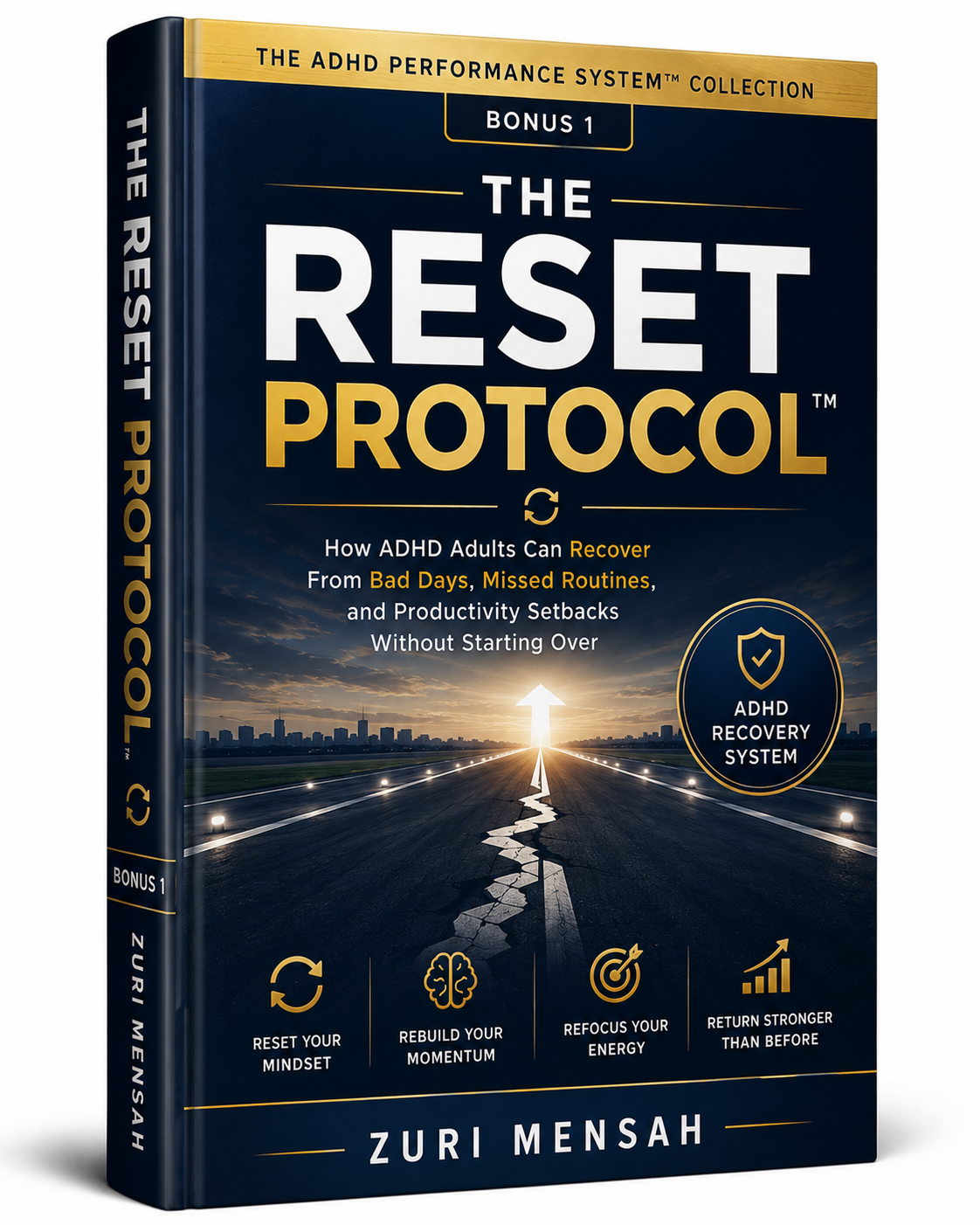
How to recover when your routine breaks. The three-step emergency restart sequence that stops one bad morning from becoming a bad week. Because even the best systems break — what matters is how fast you return. This bonus ensures you never fully fall off again.
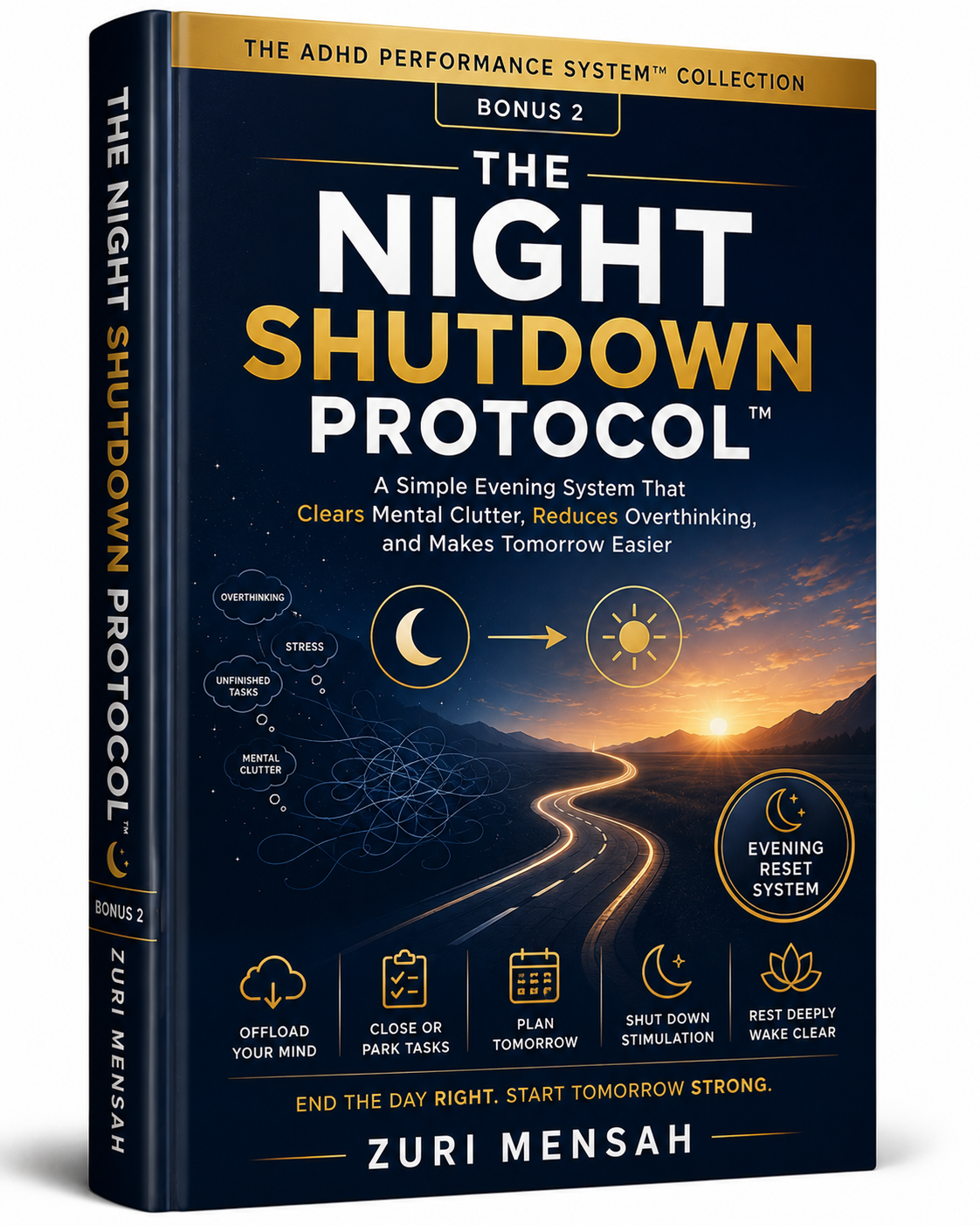
A simple evening system that clears mental clutter, reduces overthinking, and makes tomorrow easier before it begins. The missing half of The Runway Routine™ — because what you do the night before determines whether the morning sequence is easy or hard. Five simple steps to end the day right and start the next one strong.

How ADHD adults protect their focus, eliminate attention leaks, and get more done without working harder. Five environment design layers that protect your attention during execution blocks — not by fighting distractions, but by reducing your exposure to them when it matters most.
Everything You Are Getting Today

- The Runway Routine™ — The Complete Guide
₦25,000 - BONUS 1: The Reset Protocol™
₦5,000 - BONUS 2: The Night Shutdown Protocol™
₦5,000 - BONUS 3: The Distraction Shield Protocol™
₦5,000
Right Now, You Have Two Choices
Choice 1: Do Nothing
- Tomorrow morning looks like this morning.
- The same scattered start. The same momentum lost before 9am.
- Another week of feeling behind before the day begins.
- Another month of watching your goals stay exactly where they are.
- Another year of knowing what you are capable of — and not being able to access it.
Choice 2: Get The Runway Routine™
- You follow a five-gate sequence that moves your brain into focused action without a fight.
- By Day 5, the resistance begins to shrink.
- By Day 7, you forget to monitor whether you are focused — because you already are.
- Your mornings become yours again. Your goals stop being "one day" and start being this week.
- The version of yourself you have been describing to people — you start becoming that person.
🛡 30-Day Money-Back Guarantee
Follow The Morning Activation System™ for 30 days. Go through the five gates every morning. Implement the sequence as written — no shortcuts. If you do not experience a meaningful shift in how your mornings feel and how much focused work you are able to do, contact me directly for a full refund. No questions asked. Your investment is completely protected.
One Last Thing…
Picture yourself one month from today. You wake up. You follow the sequence — it takes less than thirty minutes and by now it is completely automatic. You sit down. You begin your anchor task. And within minutes you are already inside focused work, without a battle, without negotiation, without the familiar dread.
Will you look back at this month and feel the difference?
Will your work reflect what you are actually capable of — instead of a fraction of it?
Will the people around you notice something different about you? Not something dramatic. Just — presence. Calm. Follow-through.
Will you finally stop describing yourself as someone who "struggles in the mornings" — because that is simply no longer true?
Now picture yourself one month from today if you close this page. The same morning. The same scattered start. The same gap between what you intend and what you do. The same weight of another wasted morning sitting with you at lunch.
The difference between those two versions of you is a decision you make in the next sixty seconds.
If you have read this far and you are still hesitating —
I want to say something directly. The hesitation you feel right now is not caution. It is the same pattern that has been keeping you stuck every morning. The same voice that says "maybe later." The same habit of deferring the thing that would actually help.
You have already spent more than ₦7,500 on planners that lasted two weeks. On apps you never opened. On courses built for a different brain.
This is ₦7,500 for a system designed specifically for how your brain works. For mornings that finally belong to you. For the version of yourself you have been promising yourself for years.
If you cannot invest ₦7,500 in your own focus and your own future — what signal does that send to yourself about what you believe you deserve?
Stop hesitating. Choose yourself.
P.S. — Your investment is completely protected by a 30-day money-back guarantee. Follow the system for 30 days. If your mornings have not shifted, you get a full refund. There is no risk here — only upside.
P.P.S. — This price of ₦7,500 is only available for the first 100 people. After that, the guide returns to its standard price of ₦25,000. If you are reading this, the offer is still open. But it will not be for long.
P.P.P.S. — Every day you wait is another morning lost. Another day that belongs to distraction instead of you. Another 24 hours of being capable of more than you are producing. The gap between who you are and who you are trying to become does not close by itself. It closes with one decision.
Make it now.
With love for your focus and your future,
Frequently Asked Questions
How is the guide delivered after payment?
Immediately after your payment is confirmed, The Runway Routine™ and all three bonus guides are delivered directly to your WhatsApp number AND your email address — within 60 to 90 seconds. There is no manual processing. Delivery is automatic and instant. You can begin reading tonight.
Do I need any special equipment or materials to follow the system?
No. The Morning Activation System™ requires nothing you do not already have. A glass of water. Natural or indoor light. A piece of paper or notes app on your phone. That is it. There is nothing to buy, no supplements, no equipment. The entire system is built around restructuring what you already do — just in a better order.
What if my ADHD is severe? Will this still work for me?
The system was designed specifically for adults with ADHD — including those who have struggled severely with mornings for years. The 30-Day Action Plan inside the guide includes a phased approach: you implement one or two gates at a time rather than all five at once. This gradual entry is intentional and has been tested with people who described their mornings as "completely unmanageable" before starting. Severe cases take slightly longer to see results — typically by Day 7–10 rather than Day 5 — but the results are consistent.
What if my partner or family thinks this is a waste of money?
The 30-day guarantee exists precisely for this situation. You are not taking a risk. If the system does not produce a visible shift in your mornings within 30 days of following it as written, you receive a full refund. So the conversation with a skeptical partner is simple: "I am trying it for 30 days. If nothing changes, I get my money back." That is a fair trial by any standard.
Is the money-back guarantee real?
Yes. Completely real. Follow The Morning Activation System™ for 30 days, implement the five gates as described, and if you do not experience a meaningful shift in how your mornings feel and how much focused work you are able to produce — contact me directly and I will issue a full refund. No interrogation. No hassle. My reputation is built on this system working. I have no interest in keeping money from someone it did not help.
Why is this different from every other productivity system I have tried?
Every other system you have tried started too late. They assumed you were already in a state of focused readiness and gave you tools for what to do after you were productive. The Runway Routine™ is the only system specifically designed around the transition — the gap between waking up and being in focused motion. That transition is where ADHD mornings break down. And that is exactly what this system fixes. Not by making you more disciplined. By designing a sequence that removes the friction at the exact point where it does the most damage.
Get The Runway Routine™ Now — Only ₦7,500 →
© 2026 FocusLife Blog. All rights reserved. | This page is for educational and informational purposes. Individual results may vary. The guide is a digital PDF product — no physical item will be shipped.
Comments (247)
I read this entire article at 6am before I even got out of bed. Then I realised that was exactly the problem it was describing. Bought it immediately. Starting tomorrow.
👍 Like (41)The part about "you don't have a productivity problem, you have a takeoff problem" broke something open for me. I have been calling myself lazy for 10 years. I am not lazy. I was just unsequenced. Thank you Zuri.
👍 Like (87)On Day 8. The forgetting-to-check thing is real. I used to monitor my focus like a nurse monitoring a patient. Yesterday I looked up from my work and it was 1pm. I had been in flow since 8am. That has never happened to me before. Ever.
👍 Like (112)The Night Shutdown bonus alone is worth the whole price. I did not realise my bad mornings were starting the night before. I would go to bed with 15 open loops in my head and then wonder why I woke up already behind. The shutdown protocol takes 20 minutes. My sleep has improved noticeably.
👍 Like (64)I am a secondary school teacher. I tried explaining ADHD to my colleagues for years and they looked at me like I was making excuses. After reading this guide I feel like I finally have language for what I experience. And a system that actually fits it. Highly recommend.
👍 Like (49)Skeptical. Tried it. Day 5 shifted something. Now on Day 14. I have not had a scattered morning since Day 6. I do not know what to do with that information except buy copies for my siblings.
👍 Like (93)Leave a Comment